
Hair loss affects millions of men and women worldwide and continues to be one of the most emotionally impactful aesthetic and medical concerns. While surgical hair transplantation remains a gold standard for advanced hair loss, the demand for non-surgical hair restoration solutions has surged dramatically in recent years. Patients today seek treatments that are effective, comfortable, needle-free, and require little to no downtime. Physicians, on the other hand, look for technologies that are safe, versatile, evidence-based, and financially sustainable for their practices.
One of the most discussed non-surgical hair restoration technologies in recent years is Alma TED, often searched online under terms like Alma TED FDA approval. At the same time, a new generation of advanced permeation systems—most notably InFuze™ by i-Brain Robotics—is redefining what non-invasive hair restoration can truly achieve.
Understanding Alma TED FDA Approval: What It Really Means
FDA Approval vs. FDA Clearance
A common misconception among patients and even some providers is the idea that Alma TED is “FDA approved” for hair regrowth. In reality, Alma TED is FDA-cleared, not FDA-approved.
The U.S. Food and Drug Administration (FDA) distinguishes between:
FDA Approval – Typically reserved for drugs and high-risk medical devices requiring extensive clinical trials.
FDA Clearance (510(k)) – Granted when a device is deemed substantially equivalent to an already legally marketed device.
Alma TED received FDA 510(k) clearance as an acoustic wave–based device intended for use on the scalp. This clearance confirms that the device is safe to use within its intended parameters, but it does not imply FDA endorsement of hair regrowth claims.
This distinction is crucial when evaluating non-surgical hair restoration technologies and comparing them to more advanced delivery platforms like InFuze™.
What Is Alma TED?
Alma TED (TransEpidermal Delivery) is a non-invasive hair treatment device developed by Alma Lasers. It uses acoustic sound waves to enhance scalp permeability and assist in the topical delivery of hair-supporting compounds.
Core Technology Behind Alma TED
Acoustic sound wave energy
Mechanical stimulation of the scalp
Surface-level enhancement of topical absorption
No needles, no injections
Minimal discomfort and no downtime
Alma TED is positioned as a comfortable alternative to injection-based therapies such as PRP or mesotherapy.
Limitations of Alma TED in Clinical Practice
While Alma TED FDA clearance establishes safety, several limitations become evident when the technology is evaluated more deeply from a physician’s and patient’s perspective:
1. Limited Depth Control
Acoustic energy primarily affects the superficial scalp layers. There is limited precision in targeting follicular structures, where hair regeneration processes occur.
2. Restricted Compatibility
Alma TED typically relies on pre-defined topical formulations, limiting a physician’s ability to customize treatment protocols.
3. Less Control Over Dosage
Without controlled high-velocity delivery or sealed contact, product distribution may vary from patient to patient.
4. Narrow Scope of Use
Alma TED is primarily marketed for scalp hair and does not offer the same versatility across facial or skin rejuvenation indications.
Understanding Non-Surgical Hair Restoration
Non-surgical hair restoration refers to treatments that aim to reduce hair loss, improve scalp health, and stimulate hair growth without hair transplant surgery. These treatments typically focus on:
Enhancing follicular nutrition
Improving scalp circulation
Delivering growth-supporting actives
Reducing inflammation and follicle miniaturization
Modern non-surgical solutions increasingly rely on energy-assisted transdermal delivery systems rather than simple topical products or painful injections.
Introducing InFuze™: The Next Evolution in Non-Surgical Hair Restoration
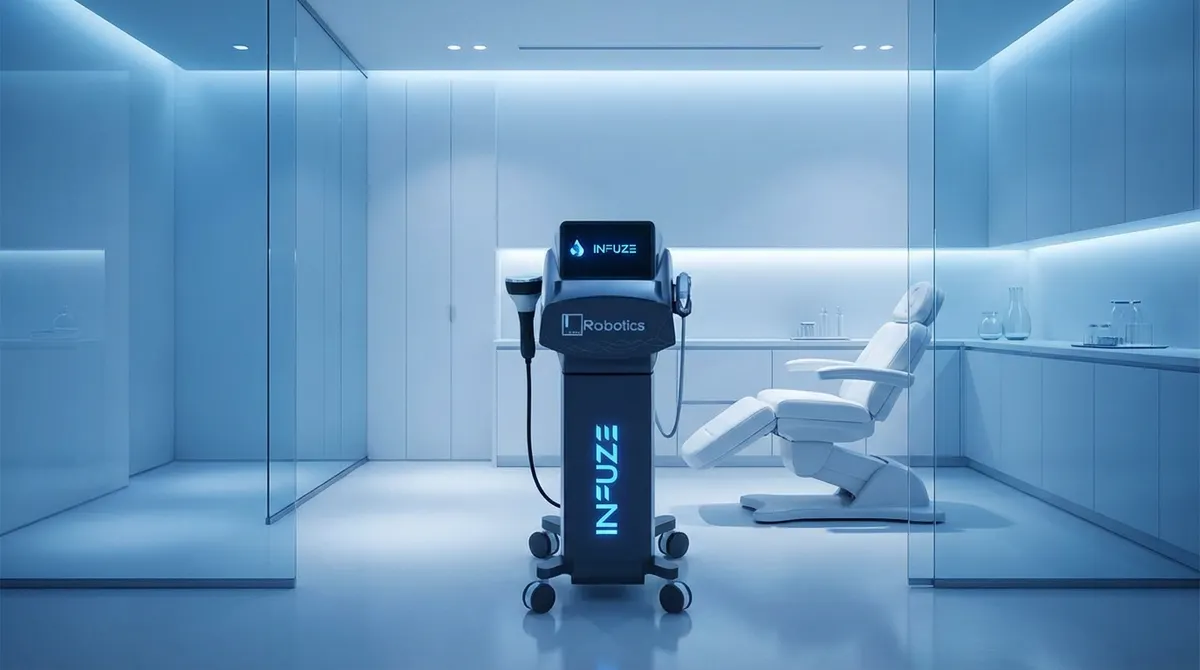
InFuze™ by i-Brain Robotics represents a more advanced, physician-driven approach to non-surgical hair restoration. Unlike surface-focused acoustic devices, InFuze™ combines focused ultrasonic permeation with pulsed high-velocity transdermal delivery, enabling deeper, more uniform, and more controlled delivery of therapeutic actives—without needles.
InFuze™ Technology Overview
Dual-Action Delivery System
InFuze™ employs a proprietary combination of:
1. Ultrasonic Permeation (40 kHz)
Low-frequency focused ultrasound temporarily enhances scalp permeability
Creates micro-channels in the stratum corneum without tissue damage
Significantly improves penetration beyond topical application
2. Pulsed High-Velocity TDA (Up to 450 m/s)
Pneumatically driven micro-bursts propel active ingredients toward follicular and dermal layers
Ensures consistent dosing and uniform distribution
Sealed-contact vacuum applicator minimizes runoff and waste
This dual-technology architecture places InFuze™ in a higher technological category than acoustic-only devices like Alma TED.
Key Features of InFuze™
Completely needle-free and painless
Compatible with exosomes, peptides, growth factors, vitamins, and custom formulations
Uniform delivery with sealed-contact precision applicator
Zero downtime and atraumatic treatment
Multi-zone capability (scalp, face, neck)
Provider-directed protocols for maximum customization
Alma TED vs. InFuze™: Side-by-Side Comparison
Technology Depth
Alma TED: Surface-level acoustic stimulation
InFuze™: Ultrasound-assisted permeation + high-velocity dermal delivery
Precision & Control
Alma TED: Limited control over depth and dosing
InFuze™: Controlled, repeatable, and uniform delivery
Formulation Freedom
Alma TED: Restricted proprietary serums
InFuze™: Works with a wide range of biologics and custom cocktails
Patient Experience
Both: Painless and non-invasive
InFuze™ advantage: More consistent results due to deeper targeting
Practice ROI
Alma TED: Single-use indication
InFuze™: Multi-indication platform (hair + skin)
Why InFuze™ Is the Better Choice for Patients
1. Completely Painless Experience
InFuze™ treatments are needle-free and atraumatic. Patients typically feel only mild warmth or gentle vibration, making the procedure ideal for individuals with needle anxiety or low pain tolerance.
2. Zero Downtime
Patients can return to work, exercise, and daily activities immediately after treatment. There is no redness, bruising, or recovery period.
3. Better Results Through Precision
By delivering bioactive compounds directly toward follicular structures, InFuze™ maximizes the effectiveness of each session, often leading to visible improvements in hair quality and density over a structured treatment plan.
4. Suitable for All Hair Loss Types
InFuze™ is effective for:
Male and female pattern hair loss
Diffuse thinning
Early androgenetic alopecia
Scalp health optimization
5. Long-Term Hair Health
Rather than offering only cosmetic improvement, InFuze™ supports follicular health, scalp circulation, and sustained hair vitality.
Why InFuze™ Is the Better Choice for Physicians
1. Clinical Flexibility
Physicians can customize treatment protocols using:
Exosomes
Growth factors
Peptides
Vitamins
Personalized bioactive cocktails
This flexibility allows providers to tailor treatments based on patient diagnosis and progression.
2. Expanded Patient Base
Because InFuze™ is painless and non-invasive, clinics can treat:
Needle-averse patients
Sensitive scalps
Diverse skin types
Early-stage hair loss patients
3. Efficient Workflow
Quick treatment sessions
Minimal setup time
Repeatable protocols
Reduced post-procedure management
This efficiency improves clinic throughput and profitability.
4. Strong Safety Profile
No needles
No tissue trauma
Controlled energy delivery
Reduced risk of infection or complications
5. Higher Patient Satisfaction and Retention
Comfortable treatments with visible results lead to:
Better compliance
Higher retention rates
Increased word-of-mouth referrals
How InFuze™ Hair Restoration Works
Step 1: Scalp Assessment
The clinician evaluates scalp condition, hair density, and hair loss pattern to determine the appropriate protocol.
Step 2: Selection of Active Compounds
Physician-selected solutions are prepared based on patient needs.
Step 3: Ultrasonic Permeation
Low-frequency ultrasound temporarily enhances scalp permeability.
Step 4: Pulsed High-Velocity Delivery
Micro-droplets are propelled toward the dermis and follicular structures with precision.
Step 5: Uniform Coverage
The sealed-contact applicator ensures consistent dosing across the scalp.
Step 6: Post-Treatment
No downtime is required. Patients resume normal activities immediately.
Treatment Protocol and Expected Results
Initial Phase: 3 monthly sessions
Maintenance Phase: Periodic follow-up sessions
Visible Improvements: Often observed after the initial series
Monitoring: Progress tracked using standardized imaging or trichoscopy
Results vary based on individual biology, hair loss severity, and formulation used.
Address and Contact Information
i-Brain Robotics Inc. United States
Orlando Office:7380 West Sand Lake Rd, Dr Phillips Orlando, FL 32819, USA
Melbourne Office:310 N Wickham Rd, Unit #129Melbourne, FL 32935, USA
Email:info@ibrainrobotics.net
Phone: (352) 804-6054
Website:www.ibrainrobotics.net
Conclusion
While searches for Alma TED FDA approval reflect growing interest in non-surgical hair restoration, FDA clearance alone does not define clinical effectiveness or long-term value. Alma TED offers a safe, comfortable introduction to acoustic-based scalp treatments, but its limitations in depth, precision, and versatility are clear.
InFuze™ stands apart as a more advanced, physician-driven platform, combining ultrasonic permeation with pulsed high-velocity delivery to achieve deeper, more uniform, and more customizable results—without needles or downtime. For both patients seeking meaningful outcomes and physicians building future-ready practices, InFuze™ represents the superior evolution of non-surgical hair restoration technology.